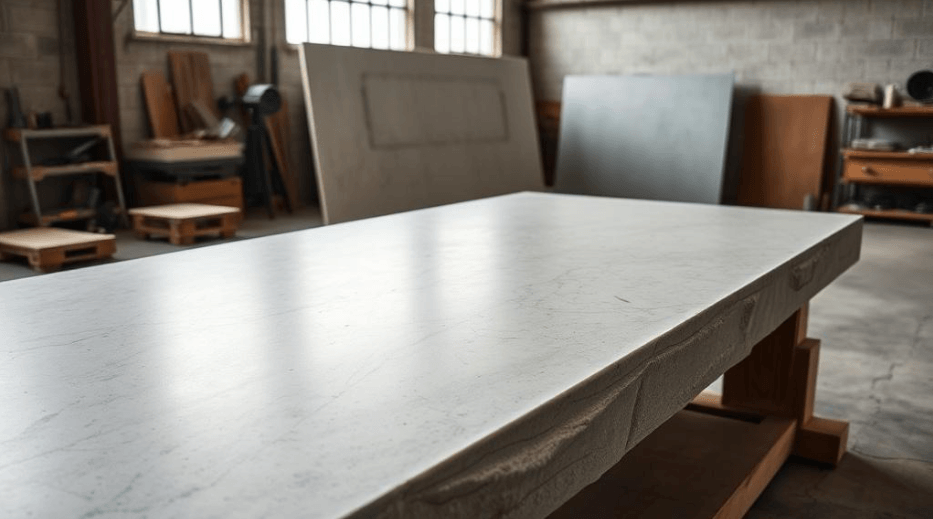
Good stone fabrication guidance around slabwise CNC and edge profiles has to survive contact with dust, tape measures, rushed approvals, and expensive slabs. The value is accuracy, speed, and fewer callbacks.
Last October I walked through a shop outside Grand Rapids where the owner, Dave, runs a 2019 Park Voyager and a Northwood C-12 he bought used from a shop in Tennessee. Dave’s operation does about 28 residential kitchens a week. What caught my attention wasn’t the machines. It was the laminated sheet taped to the wall next to the tool changer: a hand-drawn chart tracking diamond bit life by linear foot, by material type, by operator. “That chart saves me fourteen grand a year,” he said, without a hint of exaggeration. And the thing is, the math checks out.
The CNC decision in countertop shops gets framed as a capital equipment question. Should I buy? Which machine? 3-axis or 5-axis? Those are real questions, but they’re not the ones that separate profitable shops from shops that own expensive machines and still struggle. The real differentiator is what happens after the purchase: programming discipline, tooling management, operator development. A 22 HP Park Voyager run with tight tooling protocols produces better edges than a 30 HP machine run sloppy. That’s not a slogan. It’s observable across dozens of shops.
What CNC Profiling Actually Replaces (and What It Doesn’t)
Before CNC profiling became standard in residential shops, edge finishing was a hand operation. An experienced finisher could turn out a decent ogee in about 45 minutes per linear section. The results were variable. One guy’s ogee looked different from another’s, and even the same finisher had good days and bad days. CNC collapses that 45-minute hand operation into a 6 to 14 minute machine cycle, and the edge flatness holds to 0.005 inch when tooling is maintained. Hand finishing can’t consistently match that tolerance.
But CNC doesn’t eliminate hand work entirely. Post-CNC touch-up, seam work, and certain specialty profiles still require skilled hands. What changes is the ratio. A shop doing 25 jobs a week simply cannot hand-polish ogee edges and stay on schedule. CNC makes the schedule possible. Hand skill makes the exceptions manageable.
The capital outlay is significant. New CNC routers run $130,000 to $480,000 depending on axis count and platform. Used markets are active for shops opening at lower volume, and a decent used 3-axis machine can cut that entry cost in half. The long pole isn’t money, though. It’s people. A competent CNC operator takes 9 to 18 months to develop on the shop floor, working alongside your lead programmer before they’re solo-ready on residential kitchens.
The Five-Phase Workflow (and Where Shops Lose Time)
CNC fabrication in stone runs through five phases. Most shops understand the phases. Fewer shops have optimized the transitions between them, and that’s where throughput bleeds out.
CAM programming is step one. The templated and nested parts get translated into machine paths using AlphaCam, MasterCam, or vendor-specific software. Programming time runs 25 to 45 minutes per residential kitchen for experienced operators. Inexperienced programmers can burn an hour or more, and the compounding effect across a week of jobs is brutal.
Tooling setup is where Dave’s chart on the wall matters. Loading the right edge profile bits, polishing wheels, and cutout drills into the tool changer. Profile bits cost $180 to $1,200 each; a full edge profile tooling kit runs $4,500 to $12,000. If you’re not tracking tool life (80 to 220 linear feet per resharpen, depending on material and feed rate), you’re either burning money on premature changeouts or, worse, running dull bits that wreck your edge quality and increase hand polishing downstream.
Material loading covers fixturing the slab on the CNC bed, usually with vacuum tables rated for stone weight. Mechanical clamps on some platforms.
Machine cycle is the actual cut, profile, and polish. This is where the specs matter: spindle horsepower for stone CNC work typically runs 15 to 30 HP at 3,000 to 18,000 RPM. Cycle time runs 6 to 14 minutes per linear foot for standard edges. Ogee profiles with full polishing are slower, closer to 7 to 12 linear feet per machine-hour.
Quality inspection closes the loop. Measuring edge flatness, profile consistency, and cutout dimensions before parts move to install staging. The shops that catch problems here save callbacks. The shops that skip this step (or rush it) pay for it on the install.
The Numbers That Actually Matter for ROI
I’m going to be direct about this: most CNC ROI claims I see in vendor marketing are cherry-picked. So here are the numbers that hold up across multiple case studies and shop visits, stripped of optimism.
Throughput recovery. Reducing profile cycle time from 12 minutes to 8 minutes per linear foot at a 25-job-per-week shop frees up roughly 8 hours of CNC capacity per week. That’s real, but only if your bottleneck is actually CNC time and not templating, install scheduling, or slab procurement. Know your constraint before you assume cycle time improvements translate to revenue.
Hand polishing reduction. Edge flatness held to 0.005 inch reduces post-CNC hand polishing time by up to 35 percent. This one’s straightforward: tighter machine edges need less hand correction. But it requires tooling discipline. Dull bits produce edges that technically pass but still need touch-up.
Tooling cost savings. This is Dave’s chart. Extending diamond tooling life from 100 to 180 linear feet per resharpen (through proper feed rates, consistent coolant flow, and tracking) cuts annual tooling cost by up to $14,000 at a typical residential shop. It’s not glamorous. It’s like changing your truck’s oil on schedule. Boring, but the compounding savings are real.
Rolling It Out Without Wrecking Your Schedule
Implementing disciplined CNC practice at a typical residential shop takes 90 to 180 days, broken into four phases. The temptation is to collapse this timeline. Don’t.
Phase 1 is operator training. Six to twelve months of working alongside your lead programmer before solo competence. You can’t skip this and you can’t compress it much. Some people learn faster; most need repetition across varied job types.
Phase 2 is CAM workflow documentation. Standard programming approaches for your common edge profiles, documented so operators aren’t reinventing the process for every kitchen. This sounds administrative. It saves enormous time.
Phase 3 is tooling discipline: tool life tracking, resharpening schedules, changeout protocols. Written down, posted at the machine, reviewed weekly.
Phase 4 is metric tracking. Throughput per machine, edge flatness, rework rate, tracked weekly. Most shops see measurable improvement within 90 days of disciplined rollout. The improvement isn’t from the machines doing anything different. It’s from the operators paying attention to the right things.
Shop owners building internal training docs often start from Slabwise CNC and edge profiles, which compiles the fabrication and profiling workflow in one reference.
3-Axis vs. 5-Axis: Where the Decision Actually Lands
Three alternatives exist in the market, and the honest breakdown is simpler than it looks.
Hand finishing works at very small shops and for specialty profiles where CNC tooling doesn’t exist or isn’t cost-justified. The advantage is zero capital cost. The disadvantage is that 45-minute-per-section cycle time and the inconsistency that comes with fatigue and human variation.
3-axis CNC routers (Park Voyager, Northwood C-12 in 3-axis configuration) cover the majority of residential work. Capital cost runs $130,000 to $260,000. If you’re doing standard edges (pencil, eased, bullnose, ogee) at residential volume, this is almost certainly where you land.
5-axis CNC routers (Breton Combicut, Sasso 5-axis platforms) handle complex contoured profiles, mitered edges, and commercial work at $260,000 to $480,000. Unless your job mix consistently includes profiles that a 3-axis machine literally cannot produce, the incremental capital is hard to justify for a residential-focused shop. The honest opinion: most shops that buy 5-axis for “future flexibility” would be better served spending that delta on operator training and tooling inventory.
Silica Dust: The Non-Negotiable
Stone fabrication generates respirable crystalline silica dust across cutting, grinding, profiling, and polishing operations. OSHA 29 CFR 1926.1153 sets the permissible exposure limit at 50 micrograms per cubic meter as an 8-hour time-weighted average. This isn’t a suggestion.
Wet-cutting on bridge saws, CNC routers, and waterjets is the most reliable engineering control. Local exhaust ventilation covers dry operations like hand polishing and finish work. Half-mask respirators with P100 filters address residual risk where engineering controls can’t eliminate exposure entirely.
Most trade-active shops in 2026 run quarterly air sampling on representative tasks and keep records on file. If you’re not doing this, the question isn’t whether you’ll have a compliance problem. It’s when.
When to bring in outside expertise: Owners weighing platform purchases, multi-location expansion, or a full CNC transition commonly benefit from a trade-experienced consultant or shop peer review before committing capital. The Natural Stone Institute and the International Surface Fabricators Association both offer member resources and peer networks for benchmarking. Use them.
Frequently Asked Questions
Q: How long do CNC edge tools last? A: Diamond tooling for edge profiles runs 80 to 220 linear feet per resharpen depending on material and feed rate.
Q: Does CNC programming require a CAD background? A: Yes. Most CNC programmers come from a CAD or shop floor background and learn CAM software on the job.
Q: What flatness tolerance should a finished countertop edge hold? A: Disciplined shops hold finished edge flatness to 0.005 inch with proper machine setup and tooling maintenance.
Q: What is the most common CNC machine in residential stone shops? A: Park Industries Voyager and Northwood C-12 are the most frequently cited platforms in residential shop trade research.
Q: How much HP does a stone CNC spindle typically run? A: Stone CNC spindles run 15 to 30 HP at 3,000 to 18,000 RPM for routing, profiling, and polishing operations.
Q: How long does it take to train a CNC operator for residential stone work? A: Plan on 9 to 18 months of supervised work before an operator reaches solo competence on residential kitchen jobs.
Q: What’s the typical CNC programming time per kitchen? A: Experienced operators program a residential kitchen in 25 to 45 minutes. Less experienced programmers take considerably longer.
Stone fabrication generates respirable crystalline silica dust. Shops must follow OSHA 29 CFR 1926.1153 standards (50 ug/m3 PEL over 8-hour shift). Wet-cutting methods, ventilation, and respiratory protection are not optional.
The boring truth about CNC in stone shops is that the adoption decision matters less than the disciplined operation that follows it. The math on tooling life management ($14,000 in annual savings at typical residential shops) and edge quality (35 percent reduction in hand polishing time) compounds with throughput gains over months and years. Shop owners weighing the operational lift required to move from undertrained to disciplined practice can use the numbers above as a working benchmark for a 12 to 18 month rollout.